
"I don't have time to meditate."
"I can't sit still for 20 minutes."
"I'm too busy to practice mindfulness."
These are the most common reasons people give for not practicing mindfulness.
But here's what most people don't realize: Mindfulness doesn't require sitting cross-legged for an hour. It doesn't need a quiet room, meditation cushion, or special setting.
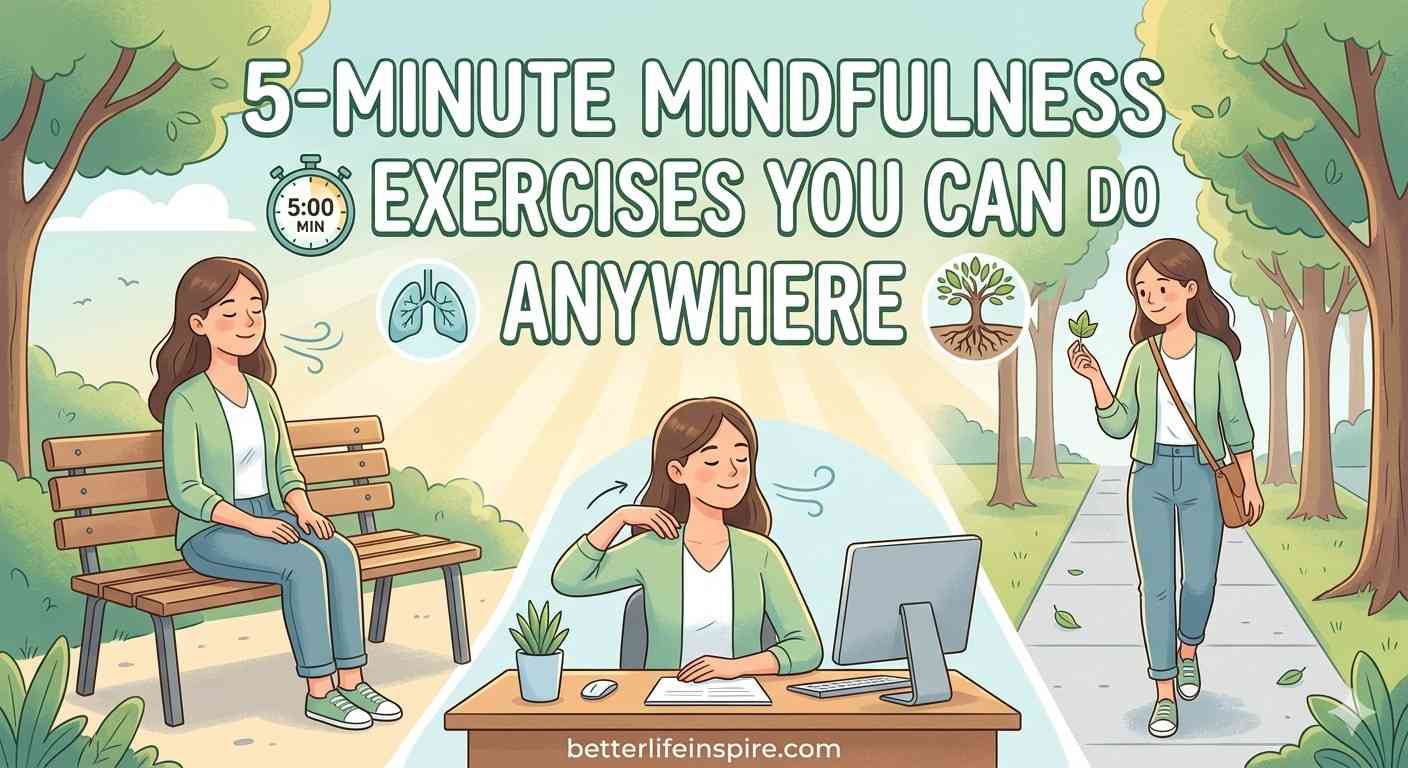
Mindfulness can happen in five minutes. Anywhere. Anytime.
At your desk. In your car. During your lunch break. Before bed. While waiting in line.
This guide gives you 12 simple mindfulness exercises you can do in just five minutes, wherever you are.
No excuses. Just presence.
What Makes These "Anywhere" Practices
These exercises share key features:
They're short: Five minutes or less. Anyone can find five minutes.
They're simple: No complicated instructions. Easy to remember and do.
They require no equipment: No apps, cushions, or props. Just you.
They're discreet: Nobody has to know you're doing them. No weird positions or chanting.
They work immediately: You'll feel the benefit right away, even as a beginner.
These are perfect for building a mindfulness habit. Start with one exercise. Do it daily. Then add others as you like.
This is the practical application of mindfulness for inner peace - bringing it into real life, not just theory.
Exercise #1: The 5-5-5 Breathing
Where: Literally anywhere - desk, car, bed, bathroom, anywhere
When: Anytime you feel stressed, anxious, or need to reset
How it works:
- Sit or stand comfortably
- Breathe in slowly through your nose for 5 counts
- Hold your breath gently for 5 counts
- Breathe out slowly through your mouth for 5 counts
- Repeat for 5 full rounds (about 2-3 minutes)
- Then breathe normally for the remaining time, noticing how you feel
Why it works:
Controlled breathing activates your parasympathetic nervous system - your body's "calm down" system.
The counting keeps your mind focused. The rhythm soothes your nervous system.
Within minutes, you'll feel noticeably calmer.
Perfect for:
- Before important meetings or conversations
- When anxiety strikes
- Before bed if you can't sleep
- Anytime you need instant calm
Exercise #2: The Five Senses Check-In
Where: Anywhere - office, home, outdoors, waiting room
When: Whenever you feel disconnected or overwhelmed
How it works:
Take one minute for each sense:
Minute 1 - See:
Notice 5 things you can see right now. Really look at them. Colors, shapes, textures. Don't just glance - observe.
Minute 2 - Hear:
Notice 4 things you can hear. Traffic, birds, humming electronics, your own breathing. Listen without judging as "good" or "bad."
Minute 3 - Feel (touch):
Notice 3 things you can physically feel. Your feet on the floor. The chair supporting you. Air on your skin. Clothes touching your body.
Minute 4 - Smell:
Notice 2 things you can smell. Even subtle scents - coffee, soap, fresh air, paper. Really focus on the scent.
Minute 5 - Taste:
Notice 1 thing you can taste. Maybe lingering flavor from food or drink. Or just the neutral taste of your mouth.
Why it works:
This grounds you in the present moment through your senses. It's impossible to be fully present with your senses while worrying about the future or past.
It interrupts anxious thinking and brings you back to NOW.
Perfect for:
- Moments of panic or overwhelm
- When stuck in your head
- Transition between activities
- Grounding when feeling scattered
Exercise #3: Mindful Hand Awareness
Where: Anywhere - meeting, commute, waiting, anytime
When: Perfect when you need to be subtle
How it works:
- Rest your hands in your lap or on a surface
- Close your eyes or keep them open (your choice)
- Bring all your attention to your hands
- Notice temperature - warm or cool?
- Notice tingling or pulsing sensations
- Notice weight and pressure where they rest
- Notice any tension - are you clenching? Release it
- Move your fingers slowly, feeling each tiny movement
- Continue for 5 minutes, just observing hands
Why it works:
Your hands have thousands of nerve endings. Focusing on them gives your mind something concrete and present to attend to.
It's deeply calming and nobody knows you're doing it.
Perfect for:
- Boring meetings or lectures
- Waiting rooms
- Public transportation
- Anytime you can't close your eyes or move
Exercise #4: The Body Scan Speed Round
Where: Best lying down or sitting comfortably, but works anywhere
When: Great before sleep or when you need to release tension
How it works:
Set a 5-minute timer. Move through your body systematically:
30 seconds each:
- Head and face (notice jaw tension, forehead, eyes)
- Neck and shoulders (often store stress)
- Arms and hands (to fingertips)
- Chest and upper back (notice breathing)
- Belly and lower back (often tight)
- Hips and glutes
- Thighs and knees
- Calves, ankles, feet, toes
- Whole body awareness (final 30 seconds)
For each area: Notice sensations. If you find tension, breathe into it. Imagine releasing it with the exhale.
Don't try to change anything. Just notice.
Why it works:
We carry tension we don't realize. This practice brings awareness to your body, often automatically releasing what you discover.
The quick pace keeps beginners from getting bored.
Perfect for:
- Before bed
- After exercise
- When body feels tense
- Connecting mind and body
This is a faster version of practices described in finding inner peace through mindfulness.
Exercise #5: Mindful Walking (Mini Version)
Where: Any space you can walk - hallway, around your room, outside
When: Great for restless energy or sitting too long
How it works:
Walk very slowly for 5 minutes:
- Feel your weight shift from one foot to the other
- Notice lifting your foot
- Notice moving it forward through air
- Notice placing it down - heel, sole, toes
- Notice the ground beneath you
- Keep attention on pure physical sensation of walking
- When mind wanders (it will), return to feeling feet
No destination. Just walking to walk.
Why it works:
Movement + mindfulness = accessible meditation for people who can't sit still.
The slow pace forces presence. You can't walk mindfully fast.
Perfect for:
- Breaking up work sessions
- When you're antsy or restless
- Getting outside during break
- Active meditation alternative
For more on walking meditation, see mindfulness vs meditation which explains different practice types.
Exercise #6: The Single-Tasking Challenge
Where: Anywhere you're doing a routine task
When: During any daily activity
How it works:
Choose one mundane task. Do ONLY that task for 5 minutes:
Examples:
- Washing dishes - feel water, soap, movements
- Brushing teeth - taste, texture, motion
- Making coffee - aroma, sounds, steps
- Folding laundry - texture, warmth, colors
- Eating - taste, texture, chewing (mindful eating)
Rules:
- No phone
- No TV or music
- No planning or thinking
- Just full attention on what you're doing
Why it works:
We're always multi-tasking. This practices uni-tasking.
Mundane tasks become meditations. Chores become opportunities for presence.
Perfect for:
- Building mindfulness habit without extra time
- Making daily tasks more enjoyable
- Training focus and attention
- Reducing stress during routine activities
Exercise #7: Gratitude Breathing
Where: Anywhere quiet or semi-quiet
When: Morning to start your day right, or evening to end peacefully
How it works:
- Get comfortable, close eyes if possible
- Take a slow breath
- As you breathe in, think of one thing you're grateful for
- As you breathe out, feel appreciation for that thing
- Next breath: New thing you're grateful for
- Continue for 5 minutes (about 10-15 breath cycles)
Start simple:
- Your bed
- Hot water
- A person you love
- Your health
- Your home
- Food in your fridge
Why it works:
Gratitude + mindfulness = powerful mood shifter.
It's nearly impossible to feel anxious while genuinely feeling grateful.
This rewires your brain to notice good things.
Perfect for:
- Starting the day positive
- Shifting out of negative mood
- Before sleep
- Countering stress or worry
Exercise #8: The Waiting Game
Where: Anywhere you're waiting - line, traffic, appointment
When: Instead of scrolling your phone
How it works:
When you find yourself waiting, don't reach for your phone.
Instead:
Option 1: Five Senses (use exercise #2)
Option 2: Watch your breath - count 5 inhales, 5 exhales, repeat
Option 3: People watching mindfully - notice without judging or creating stories
Option 4: Body awareness - scan for tension, release it
Turn waiting from frustration into practice.
Why it works:
We waste so much time waiting and getting frustrated.
This transforms "wasted" time into valuable mindfulness moments.
You get dozens of practice opportunities weekly.
Perfect for:
- Grocery store lines
- Doctor's waiting room
- Traffic (when safely stopped)
- Waiting for computer to load
- Hold music on phone calls
Exercise #9: The Worry Break
Where: Private space where you can write (or just think)
When: When worries won't stop
How it works:
Minute 1-2: Write down every worry (or list them mentally if you can't write)
Minute 3: Look at the list. Ask: "Which of these can I do something about RIGHT NOW?"
Minute 4: For actionable items, write one tiny next step. For non-actionable items, mentally set them aside.
Minute 5: Take 5 deep breaths. Commit to doing one small action step, then letting the rest go for now.
Why it works:
Worrying is thinking about problems without solving them.
This practice sorts worries into actionable vs. not actionable.
You take control of what you can, release what you can't.
Perfect for:
- Anxiety spirals
- Middle of the night worries
- Feeling overwhelmed
- Before attempting to focus
Exercise #10: Sound Meditation
Where: Anywhere with ambient sound - inside or outside
When: Great for beginners who struggle with silence
How it works:
- Sit or lie comfortably
- Close eyes (or soften gaze)
- Listen to all sounds around you
- Don't label them or create stories ("that's a car" or "I wish it was quiet")
- Just hear pure sound - volume, pitch, rhythm, distance
- New sound appears? Notice it without judgment
- Sound fades? Notice that too
- Continue for 5 minutes
Treat sounds like clouds passing in the sky. Observe, don't attach.
Why it works:
Sound is always changing, always present. It's easy to focus on.
This teaches observation without reaction - key to mindfulness.
Perfect for:
- Noisy environments (perfect for city dwellers)
- Beginners who can't "quiet their mind"
- Training non-judgmental awareness
- When visual focus is hard
Exercise #11: The Loving-Kindness Quick Practice
Where: Anywhere you can think without distraction
When: When you need softness toward yourself or others
How it works:
Minute 1: Think of yourself. Silently say:
"May I be happy. May I be healthy. May I be safe. May I be at ease."
Minute 2: Think of someone you love. Repeat for them:
"May you be happy. May you be healthy. May you be safe. May you be at ease."
Minute 3: Think of someone neutral (cashier, neighbor). Repeat for them.
Minute 4: Think of someone difficult (optional - skip if too hard). Repeat for them.
Minute 5: Think of all beings everywhere. Repeat for everyone.
You can say it silently or whisper it. Feel the intention.
Why it works:
This cultivates compassion - for yourself and others.
It softens hard feelings. It opens your heart.
Research shows it increases positive emotions and social connection.
Perfect for:
- After conflict with someone
- When feeling lonely or isolated
- Self-compassion practice
- Opening your heart
Exercise #12: The One-Minute Reset (Emergency Practice)
Where: Literally anywhere - bathroom, closet, your car
When: SOS moments when you need instant calm
How it works:
Even shorter than 5 minutes - just 60 seconds:
Seconds 1-20: Close eyes. Take 3 very slow, very deep breaths.
Seconds 21-40: Notice where in your body you feel stress. Breathe into that spot.
Seconds 41-60: Remind yourself: "This moment will pass. I am okay right now."
Open eyes. Continue your day.
Why it works:
Sometimes you don't have 5 minutes. One minute can still help.
It's a pattern interrupt. It gives your nervous system a micro-reset.
Perfect for:
- Acute stress moments
- Before difficult conversations
- When you're about to react in anger
- Panic beginning to rise
Creating Your Practice Schedule
Don't try to do all 12 exercises daily. That's overwhelming.
Instead:
Week 1: Pick ONE exercise. Do it daily for 7 days.
Week 2: Add a second exercise OR stick with the first.
Week 3: Experiment with different exercises.
Week 4: Notice which ones you love. Make those your regulars.
Sample schedule:
Morning: Gratitude Breathing (Exercise #7) - 5 minutes
Midday: Five Senses Check-In (Exercise #2) - 5 minutes during lunch
Evening: Body Scan (Exercise #4) - 5 minutes before bed
As needed: 5-5-5 Breathing (Exercise #1) - whenever stress hits
Total time: 15 minutes daily, plus as-needed practices.
That's entirely doable.
Making It Stick
Anchor to existing habits:
"After I pour my morning coffee, I'll do Exercise #7."
"When I park my car at work, I'll do Exercise #1 before going inside."
"Before checking email, I'll do Exercise #2."
Linking to existing habits makes new ones stick.
Set phone reminders:
"Mindfulness break" at 10am, 2pm, 8pm.
When it pops up, do any 5-minute exercise.
Track your practice:
Simple calendar with checkmarks. Visual progress motivates.
Be flexible:
Missed a day? Just start again tomorrow. No guilt.
Different exercise each day? That's fine. Consistency matters more than which one.
Notice the benefits:
After 2 weeks, you'll probably notice:
- Feeling calmer overall
- Less reactive
- Better sleep
- More present
- Reduced anxiety
Noticing benefits reinforces the habit.
Common Questions
"Can I do these while doing something else?"
Some yes (like Exercise #8 while waiting). Some no (Exercise #6 is specifically about single-tasking).
True mindfulness means full attention. But imperfect practice beats no practice.
"What if my mind wanders constantly?"
That's normal! Even experienced meditators' minds wander.
The practice isn't staying focused. It's noticing when you've wandered and coming back.
Every time you notice and return, you're doing it right.
"Which exercise is best?"
Whichever one you'll actually do consistently.
Experiment. Find what resonates. That's your best practice.
"Can I do longer than 5 minutes?"
Absolutely! Five minutes is the minimum. If you want 10, 15, 20 - go for it.
Start with 5 to build the habit, then extend if desired.
"Do I need to sit a special way?"
No. Sitting, standing, lying down, walking - all work.
Comfort matters more than position.
For more foundational understanding, read mindfulness vs meditation: what's the difference.
The Real-Life Impact
Sarah, busy mom:
Uses Exercise #2 (Five Senses) every morning while kids eat breakfast. Instead of rushing and stressing, she's present with them. Five minutes transformed her mornings.
James, office worker:
Does Exercise #1 (5-5-5 Breathing) in his car before walking into work. Arrives calm instead of stressed. Uses Exercise #8 (Waiting Game) in line for lunch. Former "wasted" time now valuable.
Maria, retired, chronic pain:
Exercise #4 (Body Scan) before bed helps her sleep despite pain. Exercise #11 (Loving-Kindness) helps her be gentler with herself about limitations.
David, college student:
Exercise #9 (Worry Break) before studying stops his anxiety spiral. Exercise #3 (Hand Awareness) during boring lectures keeps him grounded without obvious meditation.
Different people, different exercises, same result: More presence, less stress.
The Bottom Line
Mindfulness doesn't require:
- Hours of time
- Perfect silence
- A meditation room
- Special equipment
- Expert instruction
It requires:
- 5 minutes
- Willingness to be present
- Consistent practice
You have 5 minutes. You know you do.
That time you spend scrolling social media? That's 5 minutes.
Watching one less YouTube video? That's 5 minutes.
Hitting snooze? That's 5 minutes.
The time exists. The question is: Will you use it?
These 12 exercises give you options for any situation, any mood, any time of day.
Pick one. Do it today. Do it tomorrow. Keep going.
Five minutes of mindfulness daily will change your life more than hours of thinking about mindfulness.
This is finding inner peace in practice - not just in theory.
Your action right now:
Choose one exercise from this guide.
Do it. Right now. Five minutes.
Then do it again tomorrow.
That's how you build a mindfulness practice. One five-minute session at a time.
Start now. Your calmer, more present life is waiting.
Quick Exercise Finder:
Need immediate calm? → Exercise #1 (5-5-5 Breathing)
Feeling overwhelmed? → Exercise #2 (Five Senses)
In a boring meeting? → Exercise #3 (Hand Awareness)
Before bed? → Exercise #4 (Body Scan)
Restless energy? → Exercise #5 (Mindful Walking)
During daily tasks? → Exercise #6 (Single-Tasking)
Want positivity? → Exercise #7 (Gratitude Breathing)
Waiting in line? → Exercise #8 (Waiting Game)
Mind racing with worries? → Exercise #9 (Worry Break)
Noisy environment? → Exercise #10 (Sound Meditation)
Need more compassion? → Exercise #11 (Loving-Kindness)
Emergency SOS moment? → Exercise #12 (One-Minute Reset)
Pick one. Do it now. 5 minutes. Go. 🧘♀️