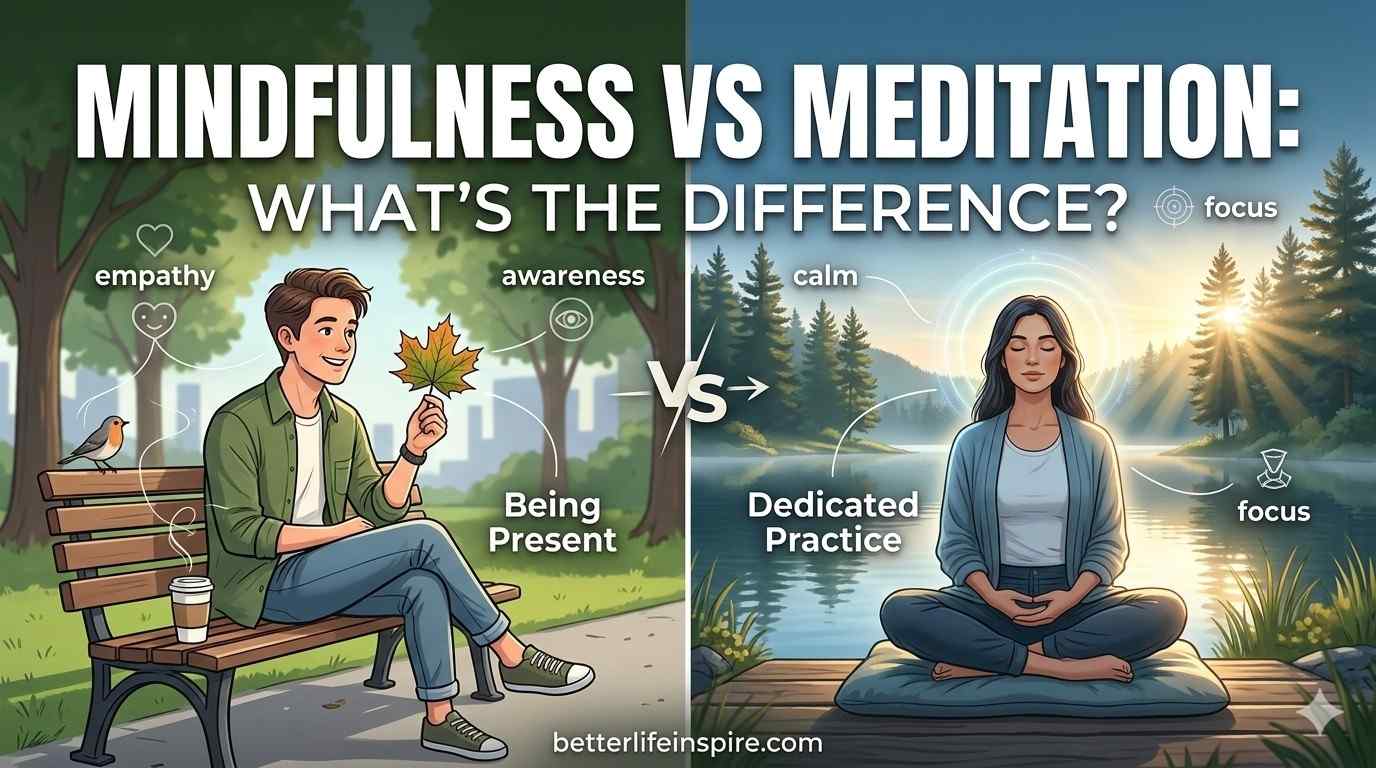

"Just meditate." "Be more mindful." "Practice mindfulness meditation."
You've probably heard these phrases thrown around. Maybe you've even used them yourself.
But here's a common confusion: Are mindfulness and meditation the same thing? Can you do one without the other? What's the actual difference?
Most people use these terms interchangeably. But they're not quite the same - and understanding the difference can help you build practices that actually fit your life.
Let's clear up the confusion once and for all.
The Simple Answer
Here's the clearest way to understand it:
Mindfulness is a way of being.
Meditation is a formal practice.
Mindfulness is a state of awareness you can bring to any moment. You can be mindful while washing dishes, walking, eating, or talking to a friend.
Meditation is a dedicated practice where you set aside time to train your mind. You sit down (or sometimes lie down) specifically to meditate.
Think of it this way:
- Meditation is like going to the gym
- Mindfulness is like using those muscles throughout your day
Still confused? Let's go deeper.
What Is Mindfulness?
Mindfulness means paying attention to the present moment without judgment.
That's it. It's surprisingly simple in concept.
The three key elements:
1. Present moment awareness:
You're fully here, now. Not replaying the past. Not worrying about the future. Just experiencing right now.
2. Non-judgmental observation:
You notice things without labeling them as "good" or "bad." You just observe: "I feel tension in my shoulders" rather than "This pain is awful and shouldn't be happening."
3. Intentional attention:
You're choosing to pay attention. It's not accidental awareness - it's purposeful.
Mindfulness in action:
You're eating an apple mindfully:
- You notice its color, texture, weight in your hand
- You hear the crunch with the first bite
- You taste the sweetness and tartness
- You feel the juice, the texture as you chew
- You're fully present with the experience of eating this apple
That's mindfulness. No special position. No quiet room. Just full attention to what you're doing.
Mindfulness throughout your day:
You can be mindful:
- Brushing your teeth (feeling the bristles, taste of toothpaste, movements)
- Walking (feeling each step, noticing your surroundings)
- Listening to someone (giving them full attention without planning your response)
- Drinking coffee (savoring the warmth, aroma, taste)
- Waiting in line (noticing your breath, body, thoughts instead of getting frustrated)
Mindfulness turns ordinary moments into opportunities for presence and peace.
This is what makes mindfulness so accessible - you don't need special time or equipment. You just need to pay attention to what you're already doing.
What Is Meditation?
Meditation is a formal practice where you deliberately train your mind.
You set aside dedicated time - usually sitting still - to practice specific mental exercises.
Common types of meditation:
Focused attention meditation:
You concentrate on something specific - your breath, a word, a sound, a candle flame. When your mind wanders, you bring it back.
Open monitoring meditation:
You observe whatever arises - thoughts, feelings, sensations - without attaching to any of it. You're the witness, not the participant.
Loving-kindness meditation:
You deliberately cultivate feelings of compassion and love toward yourself and others.
Body scan meditation:
You systematically bring awareness to each part of your body, noticing sensations.
Walking meditation:
Slow, deliberate walking where you focus completely on the physical experience of each step.
Meditation in action:
You sit down for 20 minutes:
- You close your eyes
- You focus on your breath
- Thoughts come (they always do)
- You notice them without judgment
- You gently return focus to your breath
- You repeat this cycle many times
- You end the session
That's meditation. It's structured. It's intentional. It's dedicated time for mental training.
The Connection Between Them
Now here's where it gets interesting: Mindfulness and meditation are deeply connected.
Meditation builds mindfulness:
When you meditate, you're training your ability to be mindful. You're strengthening the "mindfulness muscle."
Think of meditation as concentrated mindfulness practice. It's easier to practice being present when you're sitting still with no distractions than when you're navigating a busy day.
The skills you develop in meditation - noticing when your mind wanders, bringing attention back, observing without judgment - transfer to daily life.
Mindfulness is the goal of meditation:
Most meditation practices aim to cultivate mindfulness. You meditate to become more mindful overall.
After meditating regularly, you might notice:
- You're more present during conversations
- You catch yourself before reacting in anger
- You notice and enjoy small moments
- You're less lost in thought and more aware of the present
You can be mindful without meditating:
Someone who never formally meditates can still live mindfully. They can bring full attention to each activity, stay present throughout their day, and respond thoughtfully instead of reactively.
You can meditate without being mindful:
It's possible to sit in meditation position but not be present. Maybe you're planning your day. Maybe you're completely lost in thought. Your body is meditating, but your mind isn't mindful.
Quality matters more than position.
Mindfulness Meditation: The Overlap
This is where the terms often get confused.
"Mindfulness meditation" is a specific type of meditation where the goal is to cultivate mindfulness.
In mindfulness meditation:
- You observe the present moment
- You notice thoughts, feelings, sensations without judgment
- You practice accepting what is rather than wanting it to be different
- You gently return attention when your mind wanders
So mindfulness meditation is meditation (the formal practice) aimed at developing mindfulness (the state of present-moment awareness).
This is probably the most common type of meditation taught in the West. When people say "I meditate," they often mean "I practice mindfulness meditation."
To understand how to start this practice, read about finding inner peace through mindfulness.
Which One Should You Practice?
This is the big question, right? Should you meditate? Should you just be mindful? Both?
The answer: It depends on you and your goals.
Choose formal meditation if:
You want to:
- Develop deeper concentration
- Train your mind systematically
- Have a dedicated spiritual or mental practice
- Build mindfulness skills in a focused way
- Reduce stress through a proven technique
- Join a community or tradition
- Commit to regular practice
Benefits of meditation:
- Structured approach (easier for beginners)
- Clear progress markers
- Backed by extensive research
- Can address specific issues (anxiety, sleep, focus)
- Builds discipline
- Creates a dedicated self-care ritual
Choose informal mindfulness if:
You want to:
- Start simple without formal commitment
- Integrate practice into existing life
- Be more present throughout your day
- Don't have time for sitting meditation
- Prefer practical, everyday approaches
- Focus on living well, not "doing" meditation
Benefits of informal mindfulness:
- No extra time needed
- Applicable anywhere, anytime
- Less intimidating for beginners
- Immediately practical
- Flexible and adaptable
- Fits any lifestyle
The best approach? Both.
Use meditation to train mindfulness. Then apply that mindfulness throughout your day.
Meditate for 10 minutes each morning. This trains your attention and awareness.
Then bring that mindfulness to breakfast, your commute, work, conversations, evening activities.
Meditation is practice. Mindfulness is life.
How to Start With Mindfulness (No Meditation Required)
Want to be more mindful without formal meditation? Here's how:
Start with one routine activity:
Pick something you do daily:
- Morning coffee
- Brushing teeth
- Showering
- Eating one meal
- Walking to your car
Commit to doing this ONE thing mindfully every day.
How to be mindful during your chosen activity:
- Slow down (you don't have to stop, just reduce rushing)
- Use all your senses - what do you see, hear, smell, taste, feel?
- Notice when your mind wanders to thoughts
- Gently bring attention back to the activity
- Don't judge yourself for wandering - it's normal
Example: Mindful coffee drinking
Instead of scrolling your phone while drinking coffee:
- Hold the cup, notice its warmth
- Smell the aroma deeply
- Take the first sip slowly
- Notice the taste, temperature, texture
- Feel the warmth traveling down
- Put the cup down between sips
- Just be with your coffee for these few minutes
That's it. That's mindfulness practice.
Do this daily for a week. Then add a second activity.
For more everyday mindfulness practices, check out mindfulness in daily activities.
How to Start With Meditation
Want to try formal meditation? Here's the simplest approach:
Start with 5 minutes:
Don't aim for 30-minute sessions. Start small. Five minutes is enough.
Find a quiet spot:
Somewhere you won't be interrupted. A corner of your bedroom, a chair in a quiet room. Nothing fancy needed.
Get comfortable:
Sit in a chair or on the floor. Keep your back relatively straight (but not rigid). Rest your hands wherever feels natural.
You can close your eyes or lower your gaze.
Focus on your breath:
Don't change your breathing. Just notice it.
- Feel air entering your nose
- Notice your chest or belly rising
- Feel the exhale
- Notice the natural pause between breaths
When your mind wanders (it will):
Notice the thought without judgment. "Oh, I'm thinking about lunch."
Gently return attention to your breath.
This is the practice. Not staying focused - it's noticing when you've wandered and coming back.
Do this daily:
Same time, same place if possible. Morning works well for most people.
Five minutes daily beats 30 minutes once a week.
After two weeks:
If you enjoy it, extend to 10 minutes. If 5 minutes feels right, stay there.
For a complete beginner's guide, read how to start a meditation practice.
Common Questions
"Can I listen to music while meditating?"
You can, but traditional meditation is usually silent. Music can be soothing but also distracting.
If you need sound, try nature sounds or silence. Save music for relaxation, not meditation.
"My mind won't stop thinking. Am I doing it wrong?"
Your mind's job is to think. It won't stop. Ever.
Meditation isn't about stopping thoughts. It's about noticing thoughts and not getting caught up in them.
Every time you notice you're thinking and return to your breath, you're doing it RIGHT.
"Should I use an app?"
Apps like Headspace, Calm, or Insight Timer can be helpful, especially for beginners.
They provide structure, guidance, and gentle reminders. Try one for a month and see if it helps.
But they're not required. Simple breath awareness works perfectly without technology.
"How long before I see benefits?"
Some people notice changes in days - better sleep, less reactivity, more calm.
For others, it takes weeks or months.
Research shows consistent practice over 8 weeks creates measurable brain changes.
Be patient. Trust the process.
"Is mindfulness religious?"
Mindfulness has roots in Buddhism but is not inherently religious.
You can practice mindfulness and meditation regardless of your religious beliefs (or lack thereof).
Modern mindfulness is often taught in a completely secular way, backed by neuroscience rather than spirituality.
The Real-Life Impact
Let's talk about what this actually looks like in daily life.
Without mindfulness or meditation:
You're constantly thinking about the next thing. Eating breakfast while planning your day. Driving while stressed about work. Talking to your kids while checking email.
Life feels rushed. You're physically present but mentally elsewhere.
You react automatically - snapping when frustrated, worrying constantly, missing the good moments.
With mindfulness (even without meditation):
You're more present. When eating, you actually taste your food. When talking to someone, you're really there.
You notice your stress rising and can pause before reacting. You catch the sunset. You hear what your child is really saying.
Life slows down, not because you're doing less, but because you're actually experiencing what you're doing.
With regular meditation:
All the mindfulness benefits, plus:
- Better ability to focus when needed
- Quicker recovery from stress
- Less swept away by emotions
- More space between stimulus and response
- Deeper sense of inner calm
Your "mindfulness muscle" is stronger, so being present becomes easier.
This is the inner peace people talk about. Not the absence of problems, but the ability to stay centered amid them.
Choosing Your Path Forward
You don't have to choose between mindfulness and meditation. They work beautifully together.
But if you're just starting, here's my suggestion:
Week 1-2: Informal mindfulness
Pick one daily activity. Do it mindfully. Build the habit of present-moment awareness.
Week 3-4: Add meditation
Start with 5 minutes daily. This trains your mindfulness more deeply.
Week 5 onward: Both
Meditate for 5-10 minutes daily. Practice mindfulness throughout your day.
After a few months, this won't feel like "practice" anymore. It will just be how you live.
The Bottom Line
Mindfulness is the state - being fully present in this moment.
Meditation is the practice - dedicated time to train your mind.
You can do either without the other. But they're most powerful together.
Meditation is like strength training. Mindfulness is using that strength in everyday life.
Both are accessible. Both are free. Both are life-changing.
The question isn't "which one?" It's "which one will you start today?"
Your next step:
Right now, take three mindful breaths. That's it.
Breathe in slowly, fully present with the sensation.
Breathe out, noticing the release.
Do this three times.
Congratulations. You just practiced both mindfulness (present-moment awareness) and meditation (intentional mental practice).
See? You can do this.
Whether you choose formal meditation, informal mindfulness, or both, you're developing a skill that will serve you for life.
Start simple. Start today. Your more mindful, peaceful life is waiting.
Quick Comparison:
| Mindfulness | Meditation |
|---|---|
| State of awareness | Formal practice |
| Anytime, anywhere | Dedicated time/space |
| During activities | Usually sitting still |
| Informal | Structured |
| Applied to life | Training exercise |
| The goal | The method |
Remember: Meditation builds mindfulness. Mindfulness is living meditation.
Start today: Choose one - 5 minutes of meditation OR one mindful activity. Tomorrow, do it again.