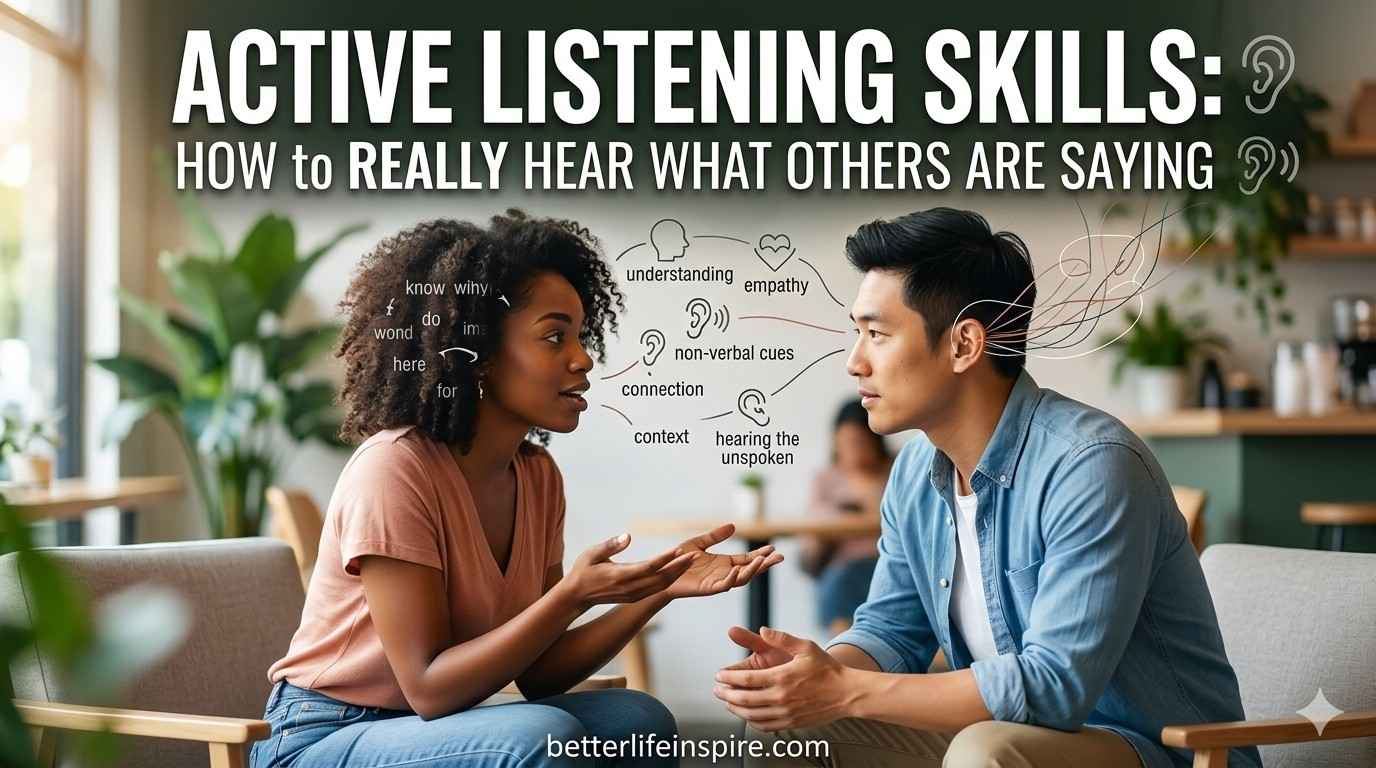

"You're not listening to me!"
Have you ever heard this? Or maybe you've said it yourself?
Most people think they're good listeners. But most people are wrong.
Real listening - the kind that makes people feel heard, understood, and valued - is rare. It's a skill most of us never learned.
We're taught to read, write, and speak. But listening? We're supposed to just figure it out.
The truth is, most of what we call "listening" is actually just waiting for our turn to talk.
Active listening is different. It's a skill you can learn. And it transforms every relationship in your life.
Let's learn how to truly listen.
What Active Listening Really Means
Active listening is paying full attention to understand someone, not to respond to them.
Notice the difference:
Passive Listening (What Most People Do):
- Hearing words while thinking about your response
- Waiting for a pause to jump in
- Planning what you'll say next
- Thinking about something else entirely
- Looking at your phone while they talk
Active Listening (What Actually Works):
- Focusing completely on the speaker
- Understanding their message and feelings
- Asking questions to clarify
- Reflecting back what you heard
- Being fully present in the moment
Active listening makes people feel valued. It builds trust. It prevents misunderstandings.
And here's the surprising part: When you listen well, people listen better to you in return.
Why Most People Are Terrible Listeners
It's not your fault if you're not a great listener. Our brains work against us.
We Think Faster Than People Talk:
The average person speaks at 125-150 words per minute. But we can process 400+ words per minute.
That gap creates mental wandering. Your brain gets bored and starts thinking about other things.
We're Distracted:
Phones, notifications, background noise, our own thoughts - there's always something competing for our attention.
We Want to Be Helpful:
When someone shares a problem, we immediately want to fix it. We jump to solutions before fully understanding.
We Want to Share Too:
Someone mentions a topic we know about, and we're eager to share our own experience or knowledge.
We Judge While They Talk:
We're evaluating, agreeing, or disagreeing instead of just listening and understanding.
Knowing these obstacles helps you overcome them.
The Core Skills of Active Listening
Let's break down the specific skills that make someone an excellent listener.
Skill #1: Give Your Full Attention
This sounds obvious, but most people don't do it.
What full attention looks like:
Put everything down. No phone. No TV. No laptop. Nothing in your hands.
Face the person. Turn your body toward them. Show physically that they have your attention.
Make eye contact. Not staring - that's creepy. Natural, comfortable eye contact that shows engagement.
Lean in slightly. This subtle body language shows interest.
Stay still. Fidgeting, looking around, or checking the time signals you want to leave.
Why it matters:
People can tell when they don't have your full attention. Even small distractions send the message: "Something else is more important than you right now."
Full attention is the foundation. Without it, the other skills don't matter.
Skill #2: Don't Interrupt
This is harder than it sounds.
When someone pauses, we often jump in. We think the pause means they're done. Usually, they're just gathering their thoughts.
How to not interrupt:
Count to three after they stop talking. Often they'll continue. The pause was just them thinking.
If you have a question, wait. Hold it until they fully finish their thought.
When you absolutely must interrupt (rarely): Say "Sorry to interrupt, but I want to make sure I understand…" Then ask your clarifying question.
Why it matters:
Interrupting breaks their train of thought. It signals your thoughts are more important than theirs.
Even positive interruptions ("Yes! I agree!" or "That happened to me too!") shift focus from them to you.
Let them finish completely.
Skill #3: Show You're Listening
Silent listening can feel cold. People need signals that you're engaged.
Verbal cues:
- "Mm-hmm"
- "I see"
- "Okay"
- "Right"
- "Go on"
These small sounds encourage them to continue without interrupting.
Non-verbal cues:
- Nodding
- Appropriate facial expressions (concerned when they're upset, smiling when they're happy)
- Leaning forward
- Open body language (uncrossed arms)
Why it matters:
These cues create a feedback loop. They show you're present and processing what they're saying.
Without them, people wonder if you're really listening or just staring blankly.
Skill #4: Reflect and Paraphrase
This is where active listening gets powerful.
After they finish a thought, reflect it back in your own words.
Examples:
They say: "My boss keeps changing the project requirements. I finish something, and then he wants it completely different."
You reflect: "So you're feeling frustrated because the goals keep moving, and your work feels wasted."
They say: "I don't know if I should take this new job. The pay is better, but it's further away, and I'd miss my current team."
You reflect: "You're torn between the financial benefits and the personal connections you value."
How to reflect:
- Use phrases like "So what you're saying is…" or "It sounds like…"
- Capture both the facts and the feeling
- Keep it brief - you're reflecting, not retelling
- Watch for their response - they'll correct you if you got it wrong
Why it matters:
Reflecting shows you truly understood. It also gives them a chance to clarify if you didn't.
People feel deeply heard when their words are reflected back accurately.
Skill #5: Ask Open-Ended Questions
Questions deepen understanding. But the type of question matters.
Closed questions (limit conversation):
- "Did that make you angry?"
- "Are you okay?"
- "Do you want my advice?"
Open questions (expand conversation):
- "How did that make you feel?"
- "What's on your mind?"
- "What do you need right now?"
More powerful questions:
- "Tell me more about that."
- "What was that like for you?"
- "How are you handling it?"
- "What's the hardest part?"
- "What would help?"
Why it matters:
Open questions invite people to share more deeply. They can't be answered with "yes" or "no."
They show genuine curiosity about the other person's experience.
Skill #6: Validate Feelings
Validation is separate from agreement. You can validate someone's feelings without agreeing with their actions or opinions.
Validation phrases:
- "That sounds really difficult."
- "I can see why you'd feel that way."
- "That would frustrate me too."
- "It makes sense you're upset."
- "I understand why that hurt."
What validation is NOT:
- Agreement with their perspective
- Saying they're right
- Solving their problem
- Diminishing their feelings with "at least…"
Example of what NOT to do:
They say: "I'm so stressed about this presentation."
Bad response: "Don't worry, you'll be fine. At least it's not a big meeting."
This dismisses their feelings.
Good response: "That does sound stressful. Big presentations can be nerve-wracking."
This validates without diminishing.
Why it matters:
People need to feel their emotions are legitimate before they can think clearly.
Validation creates emotional safety. It says "Your feelings matter. They're real."
Skill #7: Resist the Urge to Fix, Advise, or Share Your Own Story
This is the hardest skill for most people.
Someone shares a problem. You immediately want to:
- Give advice
- Share when something similar happened to you
- Offer solutions
Resist.
Most of the time, people don't want solutions. They want to be heard.
How to know if they want advice:
- They ask for it: "What do you think I should do?"
- They seem done processing: "I'm not sure what my options are."
Until then:
Just listen. Ask questions. Reflect. Validate.
If you really want to offer advice:
Ask first. "Would you like to hear what I think?" or "Do you want suggestions, or do you just need to vent?"
If they say "just vent," respect that. Keep listening.
Why it matters:
Jumping to solutions makes people feel unheard. It sends the message: "Your feelings don't matter. Here's how to fix this."
Sometimes people need to process out loud before they're ready for solutions.
Common Active Listening Mistakes
Even when trying to listen well, people make these errors:
The "Me Too" Trap:
They: "I had the worst day at work."
You: "Oh my gosh, me too! Let me tell you what happened to me…"
You just made it about you.
Better: "That sounds rough. What happened?"
The Comparison Trap:
They: "I'm struggling with my teenager."
You: "At least they're not as bad as mine was!"
This minimizes their experience.
Better: "Teenagers can be really challenging. What's been hardest for you?"
The Fix-It Trap:
They: "I feel so overwhelmed."
You: "Have you tried making a to-do list?"
They needed empathy, not solutions.
Better: "That feeling of being overwhelmed is exhausting. What's weighing on you most?"
The Question Barrage:
Asking too many questions can feel like an interrogation.
Balance questions with reflections and validation.
The Fake Listening:
Going through the motions (nodding, saying "mm-hmm") while thinking about other things.
People can tell. It's worse than not listening at all because it's dishonest.
How to Practice Active Listening
Like any skill, active listening improves with practice.
Start Small:
Pick one conversation today. Give it your full attention. Try one or two active listening skills.
Don't try to do everything at once.
Practice with Low-Stakes Conversations:
The grocery store cashier. Your coworker's small talk. The neighbor.
These brief interactions are perfect practice opportunities.
Have a Practice Partner:
Tell a friend or family member you're working on listening skills. Ask them to have a conversation where they talk for 5 minutes and you just listen and reflect.
Get feedback. What felt good? What could improve?
Notice Your Patterns:
Pay attention to when you interrupt, when you make it about you, when you jump to solutions.
Awareness is the first step to change.
Be Patient with Yourself:
You'll forget. You'll interrupt. You'll give unwanted advice.
That's normal. Notice it. Do better next time.
Active Listening in Different Relationships
The core skills are the same, but application varies:
With Your Partner:
Active listening prevents most arguments. Small issues become big ones when people don't feel heard.
Daily check-ins using active listening strengthen your bond.
With Your Children:
Kids need to feel heard. Active listening teaches them their thoughts and feelings matter.
It also models good communication skills they'll use for life.
With Friends:
Active listening deepens friendships. People remember how you made them feel.
Being a good listener makes you someone people want to talk to.
At Work:
Active listening prevents misunderstandings. It shows respect. It helps you understand what's really being asked.
Leaders who listen well have more engaged teams.
The Ripple Effect of Good Listening
When you become a better listener, something interesting happens.
People around you start listening better too. Good communication is contagious.
Your relationships deepen. Conflicts decrease. Trust increases.
People feel valued when talking to you. They share more openly. Your connections become more authentic.
This is why active listening is such a powerful relationship skill - it improves every relationship in your life.
Want to learn more about improving communication? Check out our complete guide on 6 Simple Ways to Improve Communication in Any Relationship.
Your Listening Challenge
For the next week, try this:
Day 1: Pick one conversation. Give full attention. Put your phone away. Notice how it feels.
Day 2: Practice not interrupting. Count to three before responding.
Day 3: Use reflection. After someone speaks, reflect back what you heard.
Day 4: Ask one open-ended question in a conversation. Notice how it deepens the dialogue.
Day 5: Practice validation. Acknowledge someone's feelings without trying to fix them.
Day 6: Resist giving advice unless asked. Just listen and ask questions.
Day 7: Combine all the skills in one meaningful conversation.
After one week, you'll notice the difference in how people respond to you.
Remember This
Active listening isn't about being perfect. It's about being present.
It's not about having all the answers. It's about making space for someone else to be heard.
The most powerful gift you can give someone is your full attention and genuine understanding.
In a world where everyone wants to be heard, be the person who actually listens.
That's rare. That's valuable. That's active listening.
Today's practice: In your next conversation, put your phone away and truly listen. Notice what changes.